

[Apr 07, 2026] Genuine CTFL-AcT Exam Dumps New 2026 ISQI Pratice Exam
New 2026 Realistic CTFL-AcT Dumps Test Engine Exam Questions in here
ISQI CTFL-AcT certification is an essential certification for software testers who want to specialize in acceptance testing. ISTQB Foundation Level - Acceptance Testing certification is recognized globally and is highly valued by employers in the software testing industry. ISTQB Foundation Level - Acceptance Testing certification demonstrates that the candidate has the knowledge and skills required to perform acceptance testing efficiently and effectively.
ISQI CTFL-AcT (ISTQB Foundation Level - Acceptance Testing) Exam is an important certification for individuals seeking to validate their knowledge and skills in acceptance testing. By passing CTFL-AcT exam, candidates can demonstrate their understanding of the principles and practices of acceptance testing, making them a valuable asset to any software development team. The knowledge gained through preparing for CTFL-AcT exam can also enhance an individual's ability to contribute to their organization's software development efforts.
NEW QUESTION # 12
Which of the following statements about test approaches and test techniques for acceptance testing is MOST correct?
- A. The refinement of requirements / user stories into acceptance criteria provides test conditions for the creation of acceptance tests
- B. The review of user requirements / user stories and associated acceptance criteria avoids dynamic acceptance u testing
- C. Code coverage and Test-Driven Development are generally combined with boundary value analysis in acceptance testing
- D. If exploratory tests are performed, then there is no need to cover the acceptance criteria
Answer: A
Explanation:
In ISTQB Acceptance Testing context, the process of refining requirements or user stories into acceptance criteria plays a crucial role in defining clear, testable conditions. These acceptance criteria act as the basis for deriving test conditions, which are in turn used to design acceptance test cases.
According to the ISTQB Foundation Level Acceptance Testing syllabus:
"Acceptance criteria are refined expressions of business requirements, and they help to determine the scope and intent of acceptance tests. These criteria are used to derive test conditions and guide the development of test cases." This alignment ensures that the delivered software meets the expectations set out in the requirements and satisfies the user needs. Acceptance tests are typically written from the user's perspective and are focused on verifying that the system behaves correctly in realistic business scenarios.
Option B is correct because it explicitly describes this logical and procedural relationship between user stories, acceptance criteria, and acceptance tests.
Other options are incorrect or misleading:
A is incorrect: reviewing requirements does not eliminate the need for dynamic testing.
C is incorrect: code coverage is more relevant for unit or system-level testing, not acceptance testing.
D is incorrect: exploratory testing is a valuable supplement but does not replace the need to verify acceptance criteria.
NEW QUESTION # 13
On a project to develop an event booking platform, a review session is being conducted on acceptance test cases written in Ghenkin's language. Consider the following test case:
1. GIVEN I am logged in on the event booking platform
2. AND I have selected an event from the list displayed for the "live concert" category
3. WHEN I click "Buy Tickets" buttom
4. AND I enter "3" into "Ticket quantify" field
5. AND I agree on terms and conditions
6. THEN The system should display the checkout page
7. AND I should provide my personal data for payment and eticket delivery Which of the following sentences MOST closely corresponds to a comment that could be made on this test case during the review?
- A. Line 3 refers to and element of the user interface which is to be avoided, line 4 the quantity should not be set and line 7 is an action and not a result
- B. Line 3 refers to an element to the user interface, which is to be avoided and line 7 is and action and not a result
- C. This test case is perfectly written
- D. The "When" part lacks an action to enter number of tickets request that is greater than the limit allowed per person
Answer: B
Explanation:
In Gherkin syntax (Given-When-Then), the purpose is to describe system behavior in a way that's understandable to all stakeholders. Test steps should focus on user intentions and observable results - not UI implementation details - to ensure maintainability and abstraction.
Line 3 ("click 'Buy Tickets' button") refers explicitly to a UI element, which should generally be avoided in acceptance tests. Instead, it could say "I request to buy tickets." Line 7 ("I should provide my personal data") is describing an action the user must take, not an outcome or result. In a Gherkin "Then" step, we expect an observable system response, not further user interaction.
Option C identifies both of these review concerns correctly.
Other options:
A includes an incorrect comment about line 4 ("quantity should not be set") - setting a value is acceptable.
B is false - the test case has reviewable issues.
D might be valid in a different context (e.g., boundary tests), but that's not a flaw in the existing scenario.
C). Line 3 refers to an element of the user interface, which is to be avoided and line 7 is an action and not a result
NEW QUESTION # 14
Which of the following activities is most likely performed by the business analyst as part of defect analysis?
- A. Check, whether other paths in the business process model perform as intended.
- B. Assess the impact of corrective actions on other parts of the system's implementation.
- C. Analyze the function that failed step by step to identify the cause of the defect.
- D. Identify the requirements / user stories that are not satisfied.
Answer: D
NEW QUESTION # 15
Which of the following techniques is most likely applied to ensure the quality of acceptance testing activities?
- A. Checklist-based verification of requirements to ensure their completeness and quality.
- B. Verification of the traceability between user stories and test cases to make sure it is up to date.
- C. Review of the source code to ensure traceability of user stories to system components.
- D. Eye tracking to verify the feasibility of previously defined user acceptance tests.
Answer: B
NEW QUESTION # 16
Which one of the following statements regarding the relationship between acceptance testing activities and business analysis activities is true?
- A. Test analysis activities generally produce business requirements.
- B. The join work of business analyst and testers on acceptance criteria and acceptance test cases contributes to v u the "Early Testing" best practice
- C. It is important to keep testing activities and business analysis activities as separate as possible to ensure test ^ independence
- D. In Agile, requirements engineering activities are removed and replaced by solution evaluation
Answer: B
Explanation:
"Early Testing" is a well-known best practice in software testing, promoting the involvement of testers early in the project - ideally during requirements definition - to identify ambiguities, risks, and inconsistencies.
Option B is correct because involving both testers and business analysts in defining acceptance criteria helps ensure those criteria are clear, testable, and aligned with business needs from the outset. This leads to fewer misunderstandings and defects later in the lifecycle.
Other options:
A is incorrect - Agile does not eliminate requirements engineering; it adapts it with user stories, refinement, and just-in-time elaboration.
C is incorrect - test analysis interprets existing requirements; it doesn't produce them.
D is false - while some level of test independence is valuable, Agile promotes collaboration between roles to achieve shared understanding.
B). The joint work of business analyst and testers on acceptance criteria and acceptance test cases contributes to the "Early Testing" best practice
NEW QUESTION # 17
Which one of the following statements describes correctly how acceptance testing may be augmented with other test techniques or approaches?
- A. In a model-based testing approach, acceptance tests are generated from graphical or textual models.
- B. In a black-box testing approach, acceptance test scenarios follow the implemented sequence of function calls in the code.
- C. In a risk-based testing approach, acceptance criteria are derived from the tester's experience and intuition.
- D. In a priority-based testing approach, prioritization of acceptance tests depends on identified product risks.
Answer: A
NEW QUESTION # 18
As an acceptance tester you want to test the $100 withdrawal process described by the following BPMN model.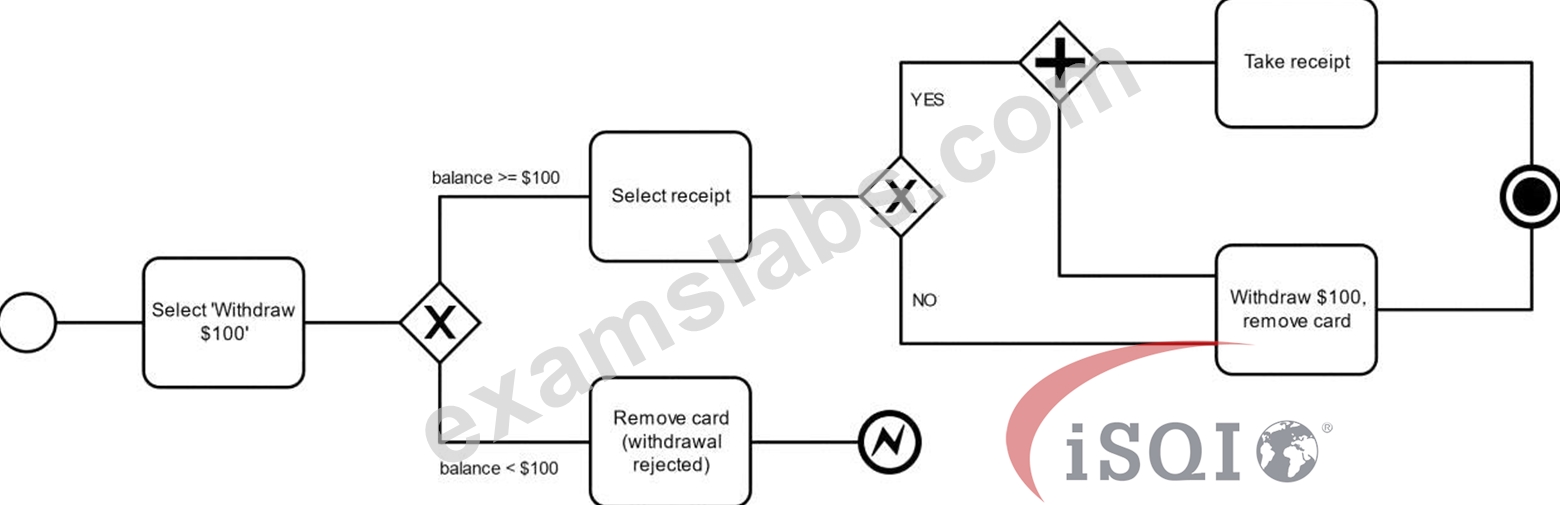
You would like to achieve decision coverage. Consider the following test cases: Test 1: balance = $100, receipt = YES Test 2: balance = $99 Test 3: balance = $120, receipt = NO Test 4: balance = $2500, receipt = YES Which of the following is the minimal set of test cases allowing to achieve full decision coverage?
- A. Test 2, Test 3
- B. Test 1, Test 2, Test 4
- C. Test 1, Test 2
- D. Test 1, Test 2, Test 3
Answer: D
NEW QUESTION # 19
Which one of the following acceptance criteria relates to security requirements?
- A. The system's response time shall not exceed 3 seconds.
- B. The system shall be web-based.
- C. Normal users shall have restricted access to private data.
- D. The graphical user interface shall comply with corporate style guides.
Answer: C
NEW QUESTION # 20
Which one of the following statements defines beta testing BEST?
- A. Beta testers discover defects in the product that escaped during the development process.
- B. During beta testing, genuine users define the acceptance criteria for various realistic configurations.
- C. Beta testing takes place early in the development process to acquire feedback from the market.
- D. Beta testing is performed by developers at the customer's location.
Answer: A
Explanation:
Beta testing is conducted after internal development and testing activities have concluded. It serves as a last line of defense before release by involving real users in real-world usage. One of its primary purposes is to uncover defects, usability problems, or configuration issues that were not found during structured testing.
Option D is correct because it captures the essential role of beta testing - to identify issues in the field that may have slipped past internal test processes, including edge cases or environmental incompatibilities that were not part of the standard test environments.
Other options are incorrect:
Option A is incorrect - beta testing is not performed by developers, and usually not at the customer's site under development supervision.
Option B is misleading - beta testing occurs late in the process, not "early in development." Option C is inaccurate - beta testing is not about defining acceptance criteria. Those should already be established. Beta testers validate the product against those criteria or their practical needs.
Exact Reference - ISTQB CTFL Acceptance Testing Syllabus (Section 3.2):
"Beta testing is performed by users and may identify defects or issues that were not found during internal testing due to differences in environments, workflows, or usage patterns."
NEW QUESTION # 21
Which tool is BEST for describing business processes and rules?
- A. Project management tool
- B. Defect tracking tool
- C. Process modelling tool
- D. Test management tool
Answer: C
Explanation:
To describe business processes and business rules in a structured, visual, and analyzable way, a process modeling tool is the most appropriate. These tools often support standards like BPMN (Business Process Model and Notation) for process workflows and DMN (Decision Model and Notation) for business rules.
Option D is correct because process modeling tools enable business analysts and stakeholders to capture, analyze, and communicate business operations and decision logic, which are foundational for acceptance test case generation in ATDD.
Other options:
A (Project management tools) manage schedules, resources, and scope, not business rules.
B (Test management tools) handle test cases and execution, not business modeling.
C (Defect tracking tools) track bugs but are not used for describing processes or rules.
D). Process modelling tool
NEW QUESTION # 22
A green courier working for an urban delivery service company uses three types of vehicles: normal bicycles, electric cargo bikes and electric vans. The following DMN table provides the rules used to select the type of zero emission vehicle to be used according to the weight (in kg) and the largest dimension (in cm) of the parcel, and the delivery distance (in km) Which one of the following statements is consistent with this DMN table?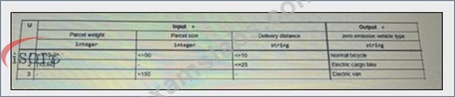
- A. Electric vans are systematically used when the parcel size is larger than 150cm
- B. When the weight of the parcel exceeds 50kg then the electric cargo bike is necessarily used
- C. Electric cargo bikes are never used for short distances
- D. Normal bicycles are mainly used for short trips regardless of the weight of the parcel
Answer: B
Explanation:
Let's analyze the DMN table shown in the image:
Rule 1: If weight #15, size #50, and distance #10 # use Normal bicycle
Rule 2: If weight is between 15 and 60 kg, size #150, and distance #25 # use Electric cargo bike Rule 3: Otherwise # use Electric van Now consider the options:
A: Incorrect - parcel size is not the only determining factor for using electric vans; it's about weight, size, and distance combined.
B: Incorrect - normal bicycles are used only when weight #15 kg, size #50 cm, and distance #10 km - so not just "short trips." C: Incorrect - electric cargo bikes are explicitly used for short trips (#25 km), per Rule 2.
D: Correct - based on the rules, any weight above 15 kg (and up to 60 kg) results in the use of electric cargo bikes. So if weight >50 kg (but #60), cargo bike is still used under the conditions of Rule 2.
Therefore, the most consistent interpretation of the decision model is:
D). When the weight of the parcel exceeds 50kg then the electric cargo bike is necessarily used
NEW QUESTION # 23
Which one of the following scenarios characterizes UX task analysis BEST?
- A. Inspirations from similar sectors are sought to identify successful solutions.
- B. Use cases are analyzed and represented through business process models.
- C. Users are qualified depending on their physical and intellectual characteristics.
- D. External conditions are considered as input for subsequent design steps.
Answer: D
Explanation:
UX task analysis focuses on understanding how users perform their tasks in real-world contexts. It captures not only the sequence of actions but also the surrounding environment - including physical conditions (light, noise), devices used, interruptions, and constraints. These external or environmental conditions become vital inputs to UX design decisions, helping teams adapt interfaces and workflows to user realities.
Option C is correct because it emphasizes this key aspect of UX task analysis: capturing external conditions that influence usability and system interaction.
Other options:
A focuses on user profiling, not task analysis.
B refers to business process modeling, which is more strategic and less user-context specific.
D refers to benchmarking or inspiration analysis - useful for design ideation but not task analysis.
C). External conditions are considered as input for subsequent design steps.
NEW QUESTION # 24
In a project to develop an online booking system, the team decided to strengthen collaborative work between the business analyst and the testers working on the project. Several concrete joint activities have been identified.
- A. Definition of Beta Testing sessions
- B. Review of risk to prioritize acceptance test
- C. Development of acceptance criteria for user stories
- D. Business needs assessment
Answer: C
Explanation:
Collaboration between business analysts and testers is critical in Agile and acceptance testing environments.
One of the most effective areas of cooperation is the joint development and review of acceptance criteria for user stories. This ensures that criteria are testable, clearly defined, and aligned with stakeholder expectations.
Option B is correct because creating acceptance criteria is where both business analysts (who understand the business needs) and testers (who ensure testability and clarity) contribute effectively.
Other options:
A (Business needs assessment) is typically a responsibility of business analysts, not a joint activity with testers.
C (Review of risk to prioritize acceptance tests) is a valuable activity but comes after criteria are defined.
While it can be collaborative, it's more specific to test planning.
D (Definition of Beta Testing sessions) is less relevant to ongoing collaborative work between testers and BAs - this involves users and release planning.
B). Development of acceptance criteria for user stories
NEW QUESTION # 25
Which one of the following statements regarding the quality of requirements is MOST correct?
- A. In Agile development lifecycle models, requirement engineering becomes less important due to the product owner role.
- B. Vague or ambiguous requirements may lead to misunderstandings both during implementation and testing.
- C. INVEST is a technique that ensure the quality of user stories or requirements, thus replacing regular reviews.
- D. Testers may complete unclear requirements by assumptions, as long as they discuss those assumptions with at least one stakeholder.
Answer: B
Explanation:
Poorly defined requirements are a leading cause of defects and project failure. According to the ISTQB CTFL Acceptance Testing Syllabus and IQBBA FL Syllabus, the quality of requirements plays a critical role in successful solution development and acceptance testing. Requirements must be clear, unambiguous, complete, and testable. When they are vague or ambiguous, stakeholders may interpret them differently, which can lead to incorrect implementations, inadequate testing, and ultimately rework or rejection during acceptance.
Option A is explicitly supported by the ISTQB Foundation Syllabus and IQBBA principles. In contrast:
Option B is incorrect because Agile lifecycles still place great emphasis on requirement engineering, even though requirements evolve iteratively.
Option C misrepresents INVEST: it is a guideline for writing good user stories but does not replace reviews or validation techniques.
Option D is risky and not endorsed by ISTQB. While testers may identify ambiguities, the correct approach is to clarify them with all relevant stakeholders, not make assumptions.
Exact Reference - ISTQB CTFL Acceptance Testing Syllabus (Section 1.3.1):
"Ambiguous, incomplete, or inconsistent requirements increase the risk of misunderstanding between stakeholders, leading to incorrect implementation and ineffective tests."
NEW QUESTION # 26
Which one of the following statements regarding performance testing is MOST correct?
- A. Performance testing aims to determine a system's robustness against malicious attacks.
- B. The performance test results serve to determine hardware and software performance requirements.
- C. The performance of the system is measured in a context that reflects, as far as possible, representative operating conditions.
- D. Depending on the model used to simulate the workload, performance tests are called load, stress or endurance / stability tests.
Answer: D
Explanation:
Performance testing assesses how a system behaves under specific conditions, typically focusing on responsiveness, stability, and resource usage. The type of performance test depends on the workload model:
Load testing evaluates performance under expected peak usage.
Stress testing pushes the system beyond its capacity to assess limits.
Endurance/stability testing checks for performance degradation over extended periods.
Option A correctly describes that performance test types are determined by the workload simulation strategy.
Other options:
B confuses performance with security testing - malicious attack robustness is a security focus, not performance.
C is partly correct but less comprehensive than A. While testing should simulate realistic conditions, categorization into stress/load/endurance is better aligned with workload modeling.
D is misleading - performance tests validate systems against performance requirements; they are not primarily used to define them.
A). Depending on the model used to simulate the workload, performance tests are called load, stress or endurance / stability tests.
NEW QUESTION # 27
......
ISQI CTFL-AcT certification is ideal for professionals who are involved in software development and testing, including testers, software developers, quality assurance professionals, and project managers. It is also suitable for individuals who wish to enhance their skills and knowledge in acceptance testing and improve their career prospects. With this certification, candidates can demonstrate their competency and expertise in acceptance testing, which can help them stand out in the job market and advance their careers.
Grab latest Amazon CTFL-AcT Dumps as PDF Updated: https://realexamcollection.examslabs.com/ISQI/ISTQB-Foundation-Level/best-CTFL-AcT-exam-dumps.html